
If you have ever stood near an F1 car when it fires up, you already know it sounds like nothing else on earth. That sharp, almost violent shriek hits you before you even see the car. It comes from an engine spinning at a rate most people can barely wrap their heads around. So just how high do these machines rev? Let’s get into it.
The Short Answer: F1’s Rev Ceiling Today
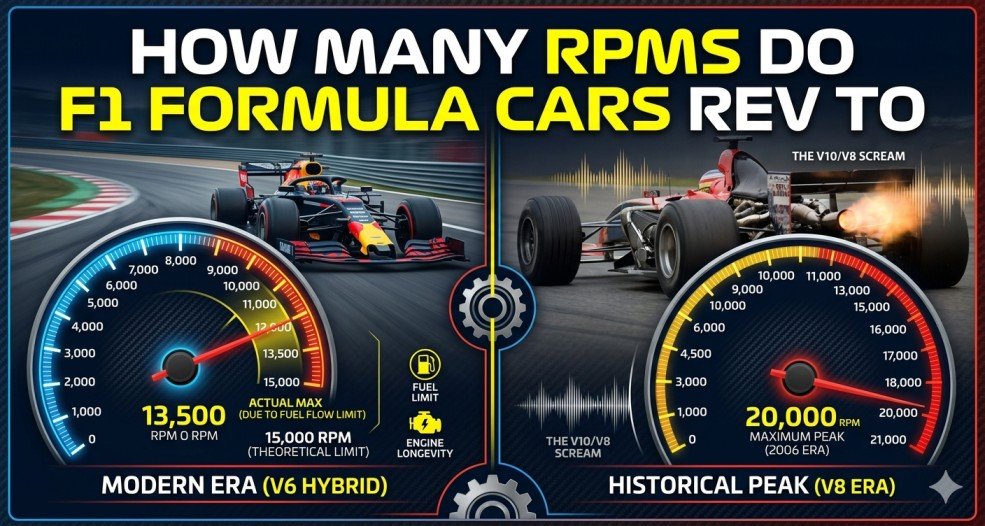
Modern Formula 1 cars rev to a maximum of 15,000 RPM. The FIA locked in that limit through the technical regulations it introduced with the hybrid power unit era in 2014, and the rules have kept that ceiling in place ever since.
To put that in everyday terms, most family cars top out somewhere between 6,000 and 7,000 RPM, and drivers rarely push anywhere near that in normal driving. An F1 engine routinely operates close to its absolute limit every single lap.
Why RPM Matters in Formula Racing
RPM stands for revolutions per minute. It tells you how many times the engine’s crankshaft completes a full rotation in sixty seconds. More revolutions mean more power strokes happening inside the engine, and more power strokes mean more energy going to the wheels.
For race engineers and drivers, RPM is not just a number on a dial. It is one of the most important levers for managing lap time, fuel consumption, and mechanical reliability all at once. When a driver drops two gears going into a tight hairpin and floors the throttle on exit, they are chasing that sweet spot where the engine delivers peak power through the rev range.
That high-pitched scream as the car accelerates out of a corner is the engine spinning toward its rev limit in a fraction of a second. It is one of the most exciting sounds in motorsport, and every bit of it comes directly from that extraordinary RPM capability.
How F1 Engine RPM Has Changed Over the Decades
The current 15,000 RPM limit is genuinely impressive, but it sits well below the peaks the sport reached in earlier eras. F1 engines have gone through a wild evolution over the past thirty years.
The Naturally Aspirated Era (1990s to 2013)
Through the 1990s and into the 2000s, F1 ran naturally aspirated engines, meaning no turbocharger assisted the combustion process. Teams pushed these engines to extraordinary limits because the regulations allowed it, and the competition to find extra RPM was fierce.
By the mid-2000s, V10 engines were regularly spinning past 19,000 RPM. Some teams reportedly hit 20,000 RPM during qualifying runs. The 2006 season brought a shift to V8 engines under new rules, and those units still climbed toward 19,000 RPM before the FIA stepped in with a rev limit to keep costs manageable and improve reliability across the grid.
When the V8 era ended in 2013, teams ran those engines with a cap at 18,000 RPM. Even with that limit in place, the sound at a race circuit was absolutely ferocious compared to what fans hear today.
The Turbo Hybrid Era (2014 to Present)
Everything changed in 2014. F1 moved to 1.6-liter turbocharged V6 hybrid power units, and the FIA dropped the maximum RPM to 15,000. That number was not arbitrary. The smaller turbocharged engine does not need to rev as high to make serious power because the turbocharger compresses the air going into the combustion chamber, letting the engine pull more energy from each stroke even at lower speeds.
The new power units actually produce more total power than their predecessors, but they get there in a different way. The hybrid system adds a significant chunk of electrical energy on top of the combustion engine output. When you have that electrical contribution, you do not need the engine spinning at 19,000 RPM to stay competitive.
That shift also explains why the sound of F1 cars changed so dramatically in 2014 and never really came back. The turbo muffles the high-frequency shriek, and the lower rev ceiling does the rest. A lot of fans still mourn those screaming V8s.
What Limits How High an Engine Can Rev
Getting an engine to spin faster sounds simple in theory. Make the parts lighter, tighten the tolerances, and let it rip. In practice, physics pushes back hard and fast.
Valve Float and Mechanical Stress
Every time a cylinder fires, valves open and close to let the air-fuel mixture in and push exhaust gases out. At extreme RPM, the valves cycle so fast that the springs holding them in place cannot keep up. Engineers call this valve float, and it causes a loss of control over the combustion process that can destroy an engine in seconds.
Teams use incredibly light titanium and exotic alloy components to fight this problem, but there is a hard physical ceiling on how fast any mechanical system can safely operate. At 15,000 RPM, the pistons in an F1 engine travel up and down around 25 times every second. The stress on every component during that motion is enormous, and keeping everything together requires engineering that borders on absurd.
Fuel and Air Mixture at High RPM
Getting the right amount of fuel and air into a cylinder at exactly the right moment gets harder as RPM climbs. At very high engine speeds, the cylinder simply does not have enough time to fill completely, and that hurts both efficiency and power output. Engineers design intake systems specifically to maintain strong airflow at high RPM, but physics still sets the ceiling on what any engine can achieve.
F1 RPM vs Road Cars and Other Motorsports
Putting 15,000 RPM in context helps you appreciate just how remarkable this engineering really is.
Compared to a Typical Road Car
A regular sedan with a 2.0-liter four-cylinder engine redlines around 6,500 RPM in most cases. Even a sporty hatchback with a performance-tuned engine usually maxes out near 7,500 RPM. An F1 engine spins more than twice as fast, and it does so using components that weigh almost nothing while surviving hundreds of miles of punishing racing.
High-performance road cars get closer. The Ferrari 296 GTB revs to about 8,500 RPM. The Porsche 911 GT3 carries a naturally aspirated flat-six that climbs toward 9,000 RPM, and enthusiasts love it for exactly that reason. Those are genuinely impressive numbers for street-legal machines, but they still fall well short of F1 territory.
Compared to MotoGP and IndyCar
MotoGP bikes actually beat modern F1 cars on raw RPM. Factory prototype machines rev to around 18,000 RPM, squeezing enormous power out of tiny four-cylinder engines by spinning at extraordinary speeds. If you want the closest sound comparison to the old F1 V10s, a MotoGP race at full volume comes closest.
IndyCar sits somewhere in the middle. The series uses 2.2-liter twin-turbocharged V6 engines that rev to around 12,000 RPM. These engines make comparable power to F1 units in certain situations, but the approach trades RPM for displacement and turbo boost instead.
What the Future Holds for F1 Engine Limits
F1 will introduce new power unit regulations in 2026. The framework keeps a similar 1.6-liter turbocharged V6 layout but pushes the electrical hybrid system’s contribution much higher. The combustion engine will produce roughly 50 percent of total power output rather than the larger share it holds today.
The 15,000 RPM limit will almost certainly stay in place under those rules. The focus for the next generation centers on sustainable fuels and greater electrical output, not chasing RPM records. The screaming V10s of the early 2000s are a piece of history that probably will not make a comeback.
What will not change is the commitment to building the most technically advanced racing engines in the world. Whether these machines spin at 15,000 or 20,000 RPM, the engineering behind every F1 power unit sits at the absolute limit of what combustion technology can do. That is worth appreciating the next time you hear one at full throttle.