
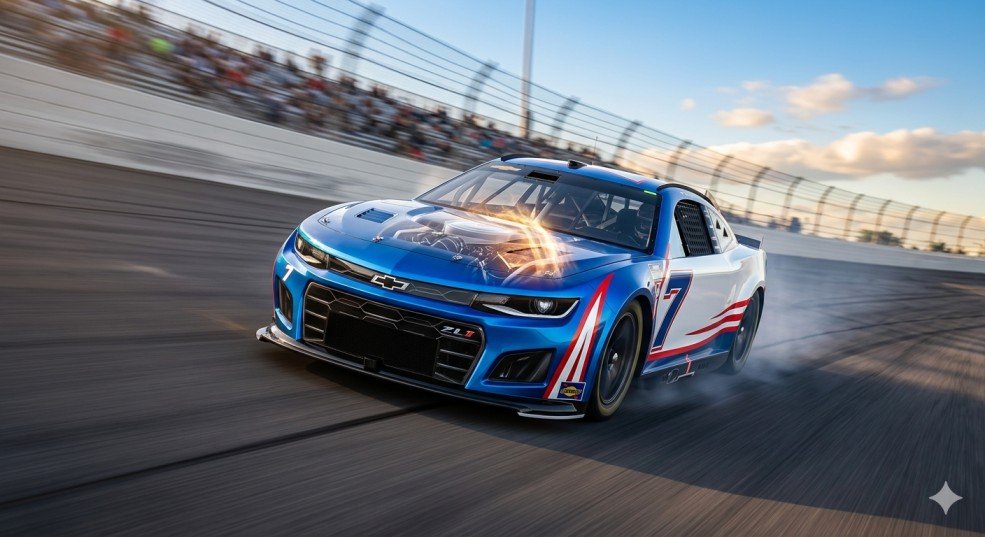
If you’ve ever watched a NASCAR race and felt your chest vibrate from the engine noise alone, you already know these cars pack a serious punch. But the exact horsepower number surprises most people, especially because it isn’t one single answer.
The Short Answer: It Depends on the Track
A NASCAR Cup Series car produces between 510 and 750 horsepower, and the number changes based on where the race takes place. NASCAR adjusts the power output for each type of track to keep racing safe and competitive. Most races currently run at 670 horsepower, though that is changing in 2026. Superspeedways like Daytona and Talladega run at a lower 510 horsepower to keep cars from going airborne at nearly 200 mph.
What Powers a NASCAR Cup Series Car?
Every Cup Series car runs a 358 cubic inch V8 engine. NASCAR builds these engines specifically for racing, with no power steering, no traction control, and no fancy driver assists. The driver does everything by feel and by instinct.
These engines rev up to around 9,000 RPM, which is roughly double what most street car engines can handle. The block looks similar to what you’d find in a regular Chevy, Ford, or Toyota, but almost nothing inside it is the same. Teams rebuild these engines completely between races, and each one costs somewhere around $100,000.
For context, your average family sedan makes around 200 horsepower. A sporty performance car might hit 400 horsepower. A NASCAR Cup car blows past both of those numbers without breaking a sweat.
How NASCAR Controls Horsepower With a Tapered Spacer
NASCAR doesn’t let teams run engines wide open. Instead, officials place a tapered spacer on top of the engine’s intake manifold. This restricts how much air and fuel flows into the engine, which directly limits how much power the engine produces.
Think of it like partially blocking a garden hose. Less flow means less pressure, and in an engine, less airflow means less combustion and less power.
In earlier decades, NASCAR used flat restrictor plates to do the same job. The tapered spacer gives officials more precision in dialing in exactly how much power each rules package allows. Teams cannot modify the spacer, and NASCAR inspects these closely before and after every race.
Horsepower by Track Type
Short Tracks and Road Courses (670 to 750 hp)
Tracks under 1.5 miles long, like Bristol and Martinsville, currently run at 670 horsepower. Starting in 2026, NASCAR will bump that number up to 750 horsepower at these venues. Fans and drivers pushed hard for this change because short track racing felt too processional with the lower power figure. More horsepower forces drivers to lift off the gas sooner, which opens the door for more passing.
Intermediate Tracks (670 hp)
Tracks in the 1.5 to 2 mile range, like Charlotte and Las Vegas, run at 670 horsepower. NASCAR feels the racing product here has stayed strong with the Next Gen car, so these tracks stay at the current number for now.
Superspeedways (around 510 hp)
Daytona and Talladega run with much lower horsepower because the banking and length of these tracks would push cars past 220 mph without the restriction. At those speeds, a small mistake sends a car airborne and into the catch fence. The lower power keeps speeds in a range where the sport can manage safety outcomes.
How Does NASCAR Horsepower Compare to a Regular Car?
Most Americans drive something that produces between 150 and 300 horsepower. Even a well-equipped pickup truck or SUV tops out around 400 horsepower. A NASCAR Cup car at 670 horsepower more than doubles what most drivers ever sit behind.
The weight difference makes it even more dramatic. A street car weighs 3,500 to 5,000 pounds. A NASCAR Cup car weighs around 3,400 pounds fully loaded with driver and fuel. You get more power in a lighter package, and that combination produces a car that reaches 60 mph in roughly three seconds and tops out well past 180 mph on most tracks.
The History of NASCAR Horsepower
NASCAR engines in the 1970s and early 1980s ran upward of 850 horsepower with relatively few restrictions. Cars went faster, but safety technology didn’t keep up with the speeds.
In 1987, driver Bobby Allison had a blowout at Talladega Superspeedway, and his car went airborne and tore through a section of the catch fence near the grandstands. Fans narrowly avoided serious injury. NASCAR responded quickly and introduced restrictor plates, which slashed horsepower down to around 410 hp at superspeedways. That change stuck for decades.
The sport went through several generations of car design after that. The Gen 5 car, known as the Car of Tomorrow, drew criticism for looking boxy and generic. The Gen 6 car from 2013 brought back manufacturer identity, with cars actually looking like a Camry or a Mustang again. Then in 2022, NASCAR launched the current Next Gen car with independent rear suspension, larger tires, and a completely new chassis platform.
The Next Gen car debuted with 670 horsepower at most tracks, down from the 750 horsepower the Gen 6 car produced. Drivers immediately noticed the difference, especially on short tracks.
What’s Changing in 2026: The 750 HP Upgrade
NASCAR officially announced in October 2025 that Cup Series cars will run at 750 horsepower starting in 2026 at all tracks measuring under 1.5 miles in length. Five tracks that previously used the intermediate package will switch over as well, including Bristol, Darlington, Dover, Nashville, and Gateway.
Officials will achieve the increase by fitting a larger tapered spacer that allows more airflow into the engine. Engineers confirmed the current engine internals can handle 750 horsepower without a full redesign, which keeps costs manageable for teams. Going beyond 750 would require new engine components and significantly shorter engine lifespans, so NASCAR landed on that number as a practical ceiling for now.
Why Horsepower Matters for the Racing Product
More horsepower changes how drivers approach a corner. With 670 horsepower, drivers stay on the throttle deep into turns because the car doesn’t overwhelm the tires as quickly. With 750 horsepower, drivers have to lift off the gas sooner, which shifts their braking points and opens gaps that trailing cars can exploit.
Denny Hamlin explained it simply: when drivers have to manage more power, passing becomes possible because cars get out of sync through the corners. That variability is exactly what makes short track racing exciting, and it’s what fans have wanted back since 2022.
Conclusion: Powerful, But Precisely Controlled
A NASCAR Cup car produces up to 750 horsepower in the current rules landscape, and that number carries a lot of engineering history behind it. NASCAR spends enormous energy balancing raw power against safety, cost, and competition quality. The 2026 increase to 750 horsepower at short tracks and road courses marks a genuine shift in that balance, one that drivers asked for and fans cheered loudly. Whether you watch for the speed, the strategy, or the sound, the horsepower number sitting under that hood shapes every single lap.