
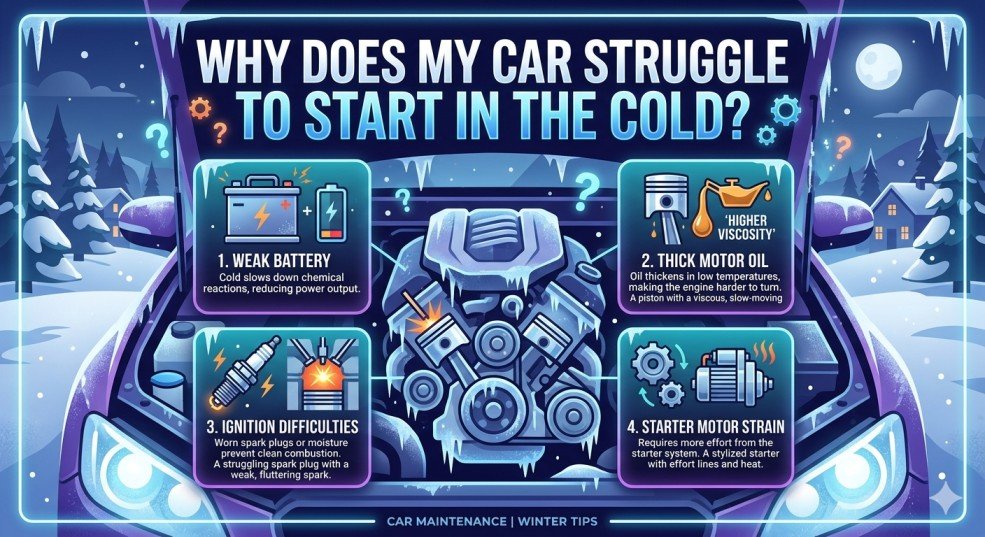
You walk out to your car on a freezing January morning, turn the key, and hear that awful slow crank sound. Or maybe the engine just clicks and refuses to fire up at all. It’s one of the most frustrating ways to start a day, and it happens to drivers everywhere every winter. The good news is there’s real science behind it, and once you understand what’s going on, you can actually do something about it.
Let me break down exactly why cold weather makes your car such a pain to start, and what you can do to keep it running smoothly all winter long.
How Cold Affects Your Battery
The battery is the number one reason cars refuse to start in cold weather. Most people blame it on something mechanical, but nine times out of ten, the battery is the real culprit.
Your car battery generates power through a chemical reaction between lead plates and sulfuric acid. Here’s the thing: cold temperatures slow that chemical reaction way down. At 32°F, a car battery loses roughly 35% of its power. Drop down to 0°F, and it can lose more than half its cranking power. At the same time, your cold engine needs more energy to turn over than it does on a warm summer day.
So you’ve got a battery working at half capacity trying to do a job that requires extra effort. That’s a recipe for a no-start situation.
If your battery is already a few years old or carrying a weak charge, cold weather will expose every flaw. A battery that starts the car just fine in September might completely give up in December. Most car batteries last three to five years, so if yours is on the older side, get it tested before winter hits. Most auto parts stores will test it for free, and that five-minute stop could save you a miserable morning.
What you can do
Keep your battery terminals clean and free of corrosion. That white or bluish crusty buildup on the terminals increases resistance and makes a weak battery even weaker. A wire brush and a little baking soda mixed with water clears it right up.
If you park outside in a really cold climate, consider a battery tender. It’s a small device that plugs into a standard outlet and keeps your battery at a healthy charge level overnight. They cost about $30 and they’re worth every penny.
Engine Oil Gets Thick in the Cold
When temperatures drop, engine oil thickens up. Think about honey sitting in your fridge versus honey sitting on a warm counter. It’s the same idea with motor oil.
Your starter motor has to turn the engine over to get it started, and thick, cold oil makes that job much harder. The starter works overtime, draining more power from your already-struggling battery. And once the engine does start, thick oil takes longer to circulate through all the moving parts, which means those parts experience more wear in those first few cold minutes.
Oil viscosity ratings tell you a lot here. That “W” in ratings like 5W-30 stands for “winter.” The lower the number before the W, the better the oil flows in cold temperatures. If you live somewhere that regularly sees temperatures below freezing, switching to a lower winter viscosity oil like 0W-20 or 5W-30 makes a real difference in how your engine turns over on cold mornings.
Check your owner’s manual for the recommended viscosity range for your climate. A lot of people run summer oil weights year-round and wonder why their car struggles every winter.
The Fuel System Feels It Too
Your fuel system deals with its own cold-weather headaches, and they show up differently depending on whether you drive a gas or diesel vehicle.
Gasoline engines: Gasoline needs to vaporize to ignite properly. Cold air makes fuel less likely to vaporize, which means the air-fuel mixture in your engine can end up too rich or too inconsistent to ignite cleanly on the first few cranks. Modern fuel-injected engines compensate for this pretty well, but older vehicles with carburetors struggle more. Even newer vehicles can take an extra second or two to fire up when temperatures get very low.
Diesel engines: Diesel fuel actually gels in extreme cold. The wax compounds naturally present in diesel begin to solidify when temperatures drop far enough, and that can clog your fuel filter or fuel lines entirely. Drivers in very cold climates often use winter-blend diesel or add a diesel antigel additive to their tank. Diesel engines also rely on glow plugs to pre-heat the combustion chamber before starting. Worn glow plugs make cold-weather diesel starts notoriously difficult.
Another fuel system issue worth knowing about is water contamination. Condensation can build up in your gas tank over time, especially if you frequently run with a near-empty tank. Water in the fuel line can freeze and block fuel delivery entirely. Keeping your tank at least half full in winter reduces the amount of air space where condensation forms.
Spark Plugs and Ignition Trouble
Even if your battery and oil are in great shape, worn spark plugs can cause a cold-start stumble. Spark plugs ignite the air-fuel mixture in your cylinders, and on a cold morning, they need to work harder to fire things up efficiently.
Worn plugs have a larger gap between their electrodes, which means they need more voltage to generate a strong enough spark. Cold temperatures reduce the efficiency of the entire ignition system, and a marginal spark plug that barely gets by in warm weather can fail outright in the cold.
If your car cranks fine but runs rough or misfires after a cold start, spark plugs are worth checking. Most plugs last 60,000 to 100,000 miles on modern vehicles, but if you’re past that mileage or notice rough idling after cold starts, swap them out. It’s a relatively affordable fix.
How to Prevent Cold-Start Problems
You don’t have to just accept cold-morning struggles as part of winter life. A few simple habits make a big difference.
Get a pre-winter inspection. Before temperatures drop, have a mechanic check your battery, test the charging system, inspect your spark plugs, and look at your belts and hoses. Cold weather finds every weak point, so catching problems in fall saves you from being stuck in winter.
Use the right oil. Switch to a winter-grade oil if you haven’t already. This is one of the easiest and most impactful changes you can make.
Let your car warm up briefly. Modern engines don’t need a long warmup, but giving it 30 to 60 seconds before driving lets the oil start circulating and the engine come up to a functional temperature. Don’t sit and idle for ten minutes, but a short warmup won’t hurt.
Keep your gas tank fuller. Running close to empty all the time invites condensation and leaves you vulnerable if the cold weather causes any unexpected fuel delivery issues.
Consider an engine block heater. If you live somewhere that regularly gets below zero, an engine block heater plugs into a standard outlet and keeps your coolant warm overnight. This makes cold starts dramatically easier on the battery, the oil, and every mechanical component in the engine. Many cars sold in cold-weather markets already have one installed.
When to See a Mechanic
If your car consistently struggles to start in cold weather despite having a healthy battery and fresh oil, take it in. A good mechanic can run a full electrical system test, check the fuel pressure, inspect the glow plugs on a diesel, and diagnose anything your DIY checks might have missed.
Cold-weather starting problems usually point to something that needs attention. Catching it early keeps a minor inconvenience from turning into a full breakdown on the coldest morning of the year.